Tuesday, June 7, 2011

On the Road. . . Korea: Vendor Food, Pt. 1

I love vendor food.  It started when I was studying in England and was introduced to late night drunk carts that spring up late and offer fried and salty alcohol minimizers.  Austin, Texas, was also a favorite food destination because they have taken vendor food and made it into a cultural identity. 
I had always heard that countries in Asia are particularly good at vendor food and was excited to try as much as possible.  The vendor food posts are split into two parts: savory and sweet. 
Savory Snacks
Eomuk and Friends
These were the first real late night vendor snacks I got to try.  Kim had taken me to the Warehouse, an expat bar where 20- and 30-somethings teaching English in Korea go to hang out.  After a couple of Cass, a Korean beer, seeing a cart of fishy, meaty, potstickery, and fried food options was like a gift from the foodie gods. 
The first one I tried was eomuk, or odeng.  I don’t really know what this is, but I love it!  It is kind of fish cake cut into long strips and then put on a stick.  They are at stalls everywhere and you tend to eat however many you want, then show the vendor the sticks.  The basic gist is that it is sheets that remind me in texture of really fluffy omelets with a hint fish.  They are cooked and floating in broth, which keeps them moist and flavorful.  I even saw someone take a cup and ladle a little broth into it to sip.  You dip the eomuk in a dark sauce that tastes like sassy soy sauce and that gives a nice saltiness.   Make sure to try them. 
The other three musketeers are fried potato cakes, potstickers, and imitation crab rolled in egg.  The one I liked the most was the potatoes, but the crab was like a lively seafood cousin of pigs in a blanket.   The potstickers were also good with light casing and chewy insides.  I’d recommend all three. 
Tteokbokki (or Ddeokbokk)
Tteokbokki is a snack of little cylinder shaped rice cakes (tteok) and eggs stir fried in gochujang.  Both times it was served in a plastic bag and then you eat it with a toothpick.  This was my all time favorite vendor food.  I first encountered the cylinder sized tteok in dak galbi and was beyond excited to find that I could get just a big old bowl of tteok.  The combination of ingredients is spicy, gummy, chewy, and tasty.  I had it once in Seoul and spent a good hour on the last night in Gangneung on a hunt for it so I could have one last helping before I went back to America.   
Dragon Bread with Bulgogi

I have had stuffed puffs at Asian restaurants in America.  These, though, were a little more like yeast bread rolls and have a nice crunchy bottom that gets a little caramelized.  They are also topped with crunchy sesame seeds on top.  The inside is oniony and meaty, but surprisingly sweet.  Korean people do appreciate sweet.  Because of the sweetness, it wouldn’t top my list of vendor foods, but it did hit the spot when I had it. 
Korean Home Fries
Kim got these during a bus ride from Gangneung to Seoul while we were stopped at a rest stop.  She said that usually they sprinkle sugar on top, but she was able to get salt instead.  They are also served with toothpicks, the vendor utensil of choice.  They are the best potatoes I’ve ever head.  Korea has some of the richest and creamiest potatoes that remind me a lot of Yukon Gold potatoes.  This treatment of them is just a simple, oil browning that makes them a little caramelized and very lip smacking good.  Perfect for an early morning breakfast nosh.  
Ddakgochi and Bundeggie
All foodie cultures worth their salt have some kind of yummy food on a stick.  Korea has Ddakgochi, or dark meat chicken cooked with a sweet teriyaki version of duck sauce.  I had it when I tried the silk worm larvae, just in case the larvae left a bad taste in my mouth. 
The description of bundeggie should go in the bizarre food post that is coming up on Sunday.  But, since bundeggie is a common vendor food, I thought I talk about it here.  I was a little nervous about them because I was afraid that being larvae, it would be really slimy and squishy.  Plus, the liquid it is served in looks like melted butter with a phemaldehyde twist. 
The taste is very surprising.  I will warn you that the taste will stay in your mouth for a quite a long time.  I was tasting bundeggie for about an hour until Kim and I had lunch.  They come in a rather large cup that is full of them.  So, get it to split, but don’t worry if you can’t eat them all since evidently even Korean people rarely finish a cup full.  The taste is a mix of earthy, inky, pickling, chewy, and nutty.  Most people had warned me that they weren’t fans, but I enjoyed them well enough. 

So, those are all my savory adventures in vendor food.  Coming up Thursday are my sweeter exploits.     

Print Friendly and PDF

Sunday, June 5, 2011

On the Road . . . Korea: Main Dishes

Over the five days I was in Gangneung and the two in Seoul, Kim tried to make sure I got to try as many of the key main dishes that I could.  Of all the ones I tried, I never once had a bad meal.  Here are the main dishes from my travels that you will want to know about. 
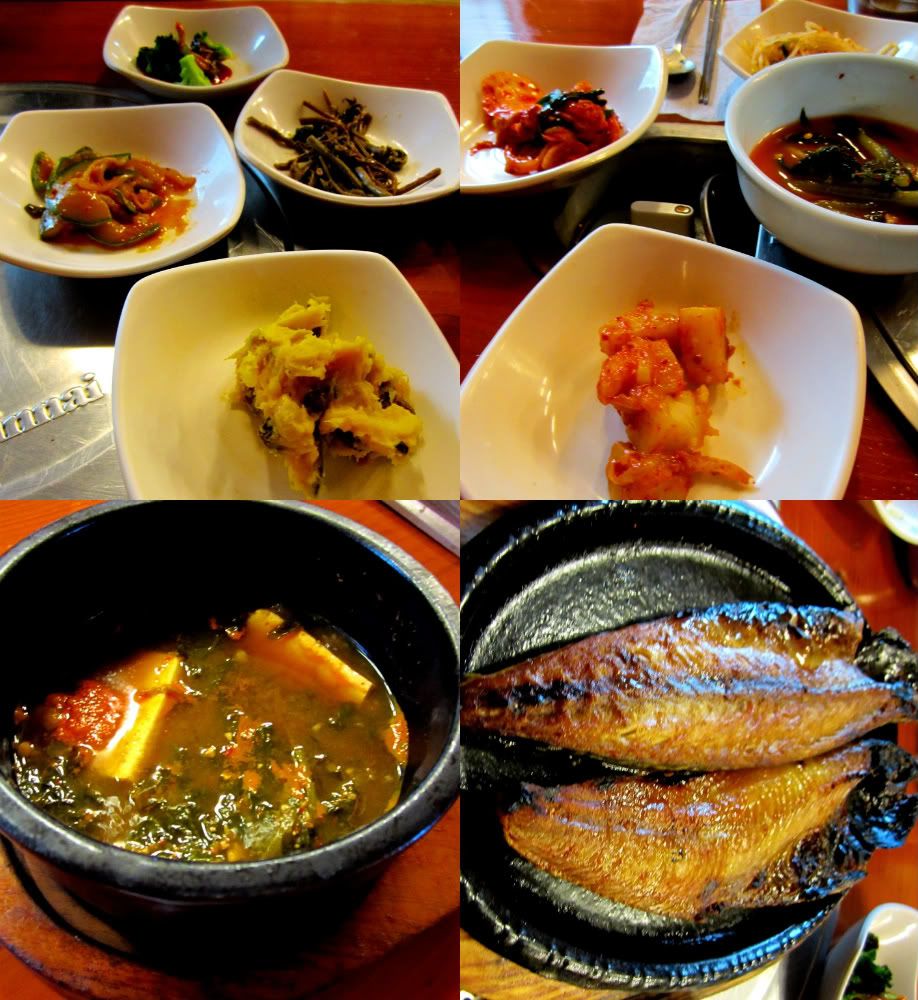
Sangung Gui = “Fish Grilled”
This was the first dish I had in Gangneung with Kim.  Next to shabu shabu, it ends up being my second favorite meal. 
The dish came with lots of sides: wilted greens in broth, spiced potatoes, cabbage leaf kimchi, slightly pickled bean sprouts, pumpkin mash, mushrooms, broccoli with gochujang, and zucchini with onions. 
The sansung gui itself was probably one of the best fish dinners I ever had.  It comes with the spine so you have to remove that.  Then, the fish is lightly seasoned and takes most of the flavor from the charring and cooking.  It gets a type of savory carmelization that makes it taste flavorful and complex. 
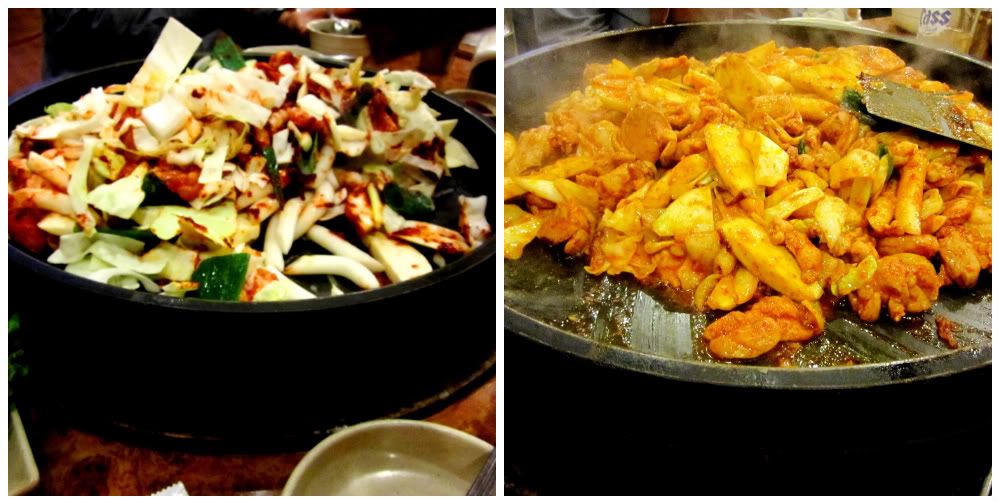
Dak Galbi (also, dalk galbi) = “Chicken Ribs” . . . although I couldn’t tell you why
Dak Galbi is a chicken that is stir fried in gochujang right at the table. 
It comes with onions, garlic, potatoes, rice dumplings (or tteok), and cabbage.  The use of the gochujang makes it spicy and you eat it with lettuce.  The place we ate at actually served it with sesame leaves that are a little spicy, peppery, and even a little minty. 

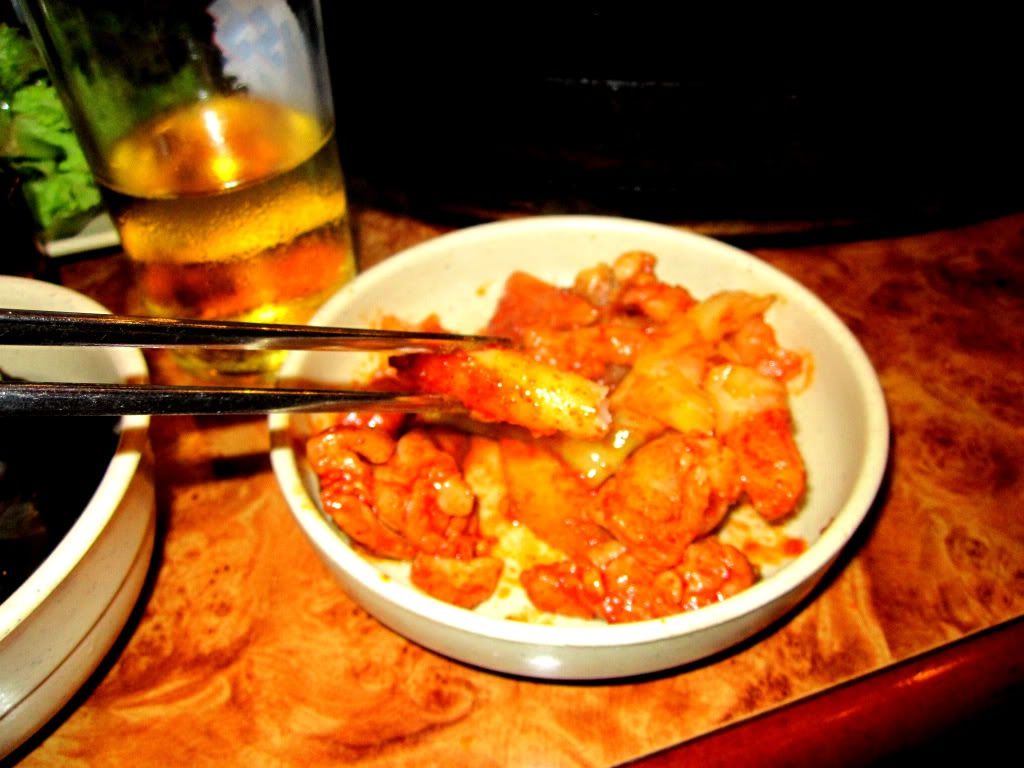
The chicken tends to be dark meat and so is a little grissly, but still rich in flavor. My favorite part of the dish was the tteok and when I discovered that I could get a bowl of just that from vendors, I was hooked. 
Shabu Shabu
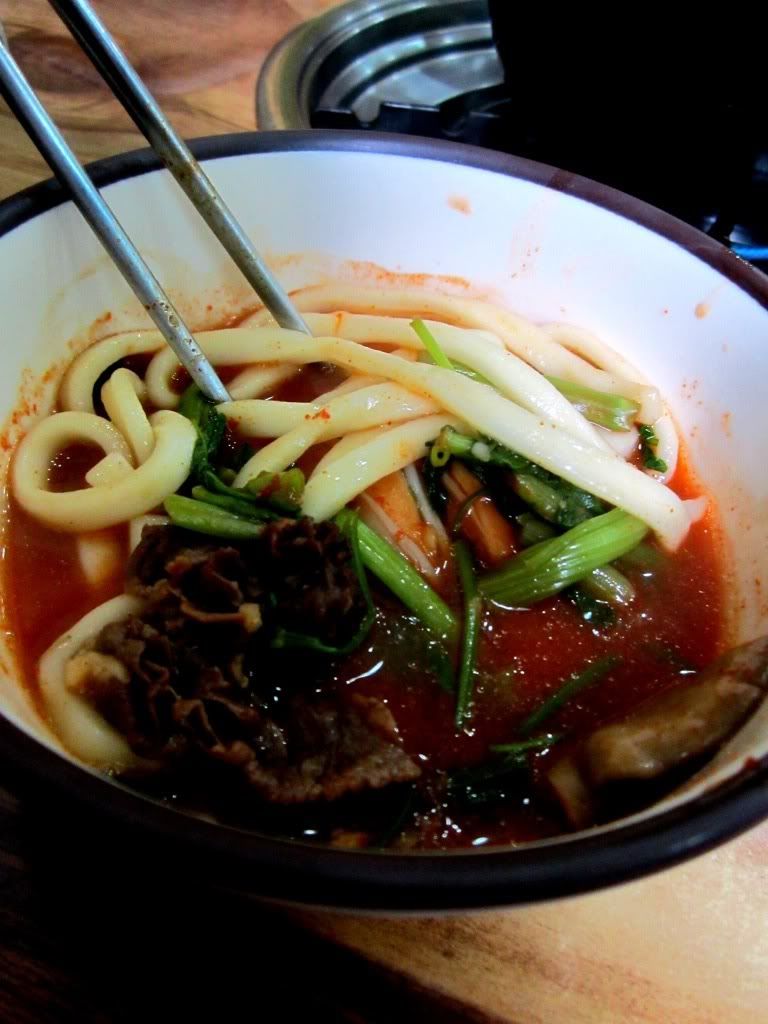
The words, “shabu shabu,” don’t really have a literal translation.  It is soup of vegetables and thinly sliced meat that is flash cooked in a rich red broth.  The one I ate had mushrooms and dropwart, udon noodles, a couple of slices of potatoes, and meat.  A large cast iron pot is brought to the table and the vegetables cook down in front of you.  Once the soup is boiling, you add some of the meat and the udon. 

Kim talked about how the soup gets “stewier and stewier”, or better and better as it continues to cook.  The broth near the end of end of the meal is particularly rich and satisfying, so it is particularly good meal for socializing—eat a little, drink a little, let the soup thicken, and eat some more.  The flavor of the broth is spicy, complex, and rich and was made even spicier and sharp from the dropwart (something that looks like cilantro but tastes more like the leafy tops of celery).  The meat also reminds me of how strong and rich jerky can get, except the meat in shabu shabu is melt in your mouth tender.   

Galbi = Ribs and Sausage Barbeque
This is one of the most fun eating experiences.  Although shabu shabu and dak galbi cook in front of you and you get some interaction, barbeque does feel very hands on.  The wait staff brings a cylinder of red coals to the table and installs it in the center.  They then put a metal grate over the coals for you to cook on.  Once that grill gets too much char on it, they’ll come through and replace it with another.  
For meats, you can get pork, sausages, or ribs.  We ordered the ribs and sausages that already come fairly precooked and are already safe to eat.  You then get to set them on the grill and char them to your heart’s content.  The ribs are spicy and tender, and the sausages remind me a lot of really nice hot dogs.  They both improve the more you grilled them, letting them get a little crispy and smoky.   
The meal also came with an egg soup (served sizzling hot in a cast iron bowl), water kimchi, thinly sliced cabbage with kiwi dressing, finely shredded greens, onions, bean sprouts, and the usual of garlic, peppers, gochujang, a type of mustardy sauce, and lettuce.  Kim introduced me to the merits of grilling the leafy kimchi and it became one of my favorite ways to eat kimchi.  It loses a bit of its tang and crispiness and instead gets smokier, fuller, and more savory.  You will want to try it because it is a great way of trying kimchi in its many forms, and the flavor changes of grilling work well with the barbequed meat.  


Coming Up Next Tuesday . . . Vendor Food
Print Friendly and PDF

Friday, June 3, 2011

On the Road . . . Korea: Grocery Stores and Outdoor Markets

Whenever I travel to a new country, or sometimes a new city in America, I make a point to visit either the grocery store or an outdoor market.  It was a habit I got into after I studied abroad in England and learned very quickly how much you can get a sense of the produce, flavors, and food choices based on the food at the grocery store.    
Visiting grocery stores and markets has a very interesting effect.  In one way, it can remind you that you and the people of the city aren’t so different.  Seeing products that you buy in America or seeing vegetables, fruits, and flavors that you find familiar and comforting help make the new place somewhat more familiar.  This effect rang true for me when I was in Ireland.  I was traveling by myself and was starting to feel a little lonely.  I had just gotten very lost in Cork and by accident ended up in their famous market.  Seeing so many foods I was familiar with and by sharing a collective experience of looking at meats, talking to vendors, and exploring food counters, reminded me of being part of a shared experience with that city. 
Conversely, markets can also remind you that you are an outsider.  In walking through a market and store in which you are unfamiliar with ingredients, food preparations, and what a food is, then it is a reminder that you are not part of foodie community.  Even the strangeness of an unfamiliar food smell can be a reminder of being “other.” 
I experienced both excitement and hesitation in Korea during my exploration of the HomePlus grocery store and then neighboring outdoor market.  The grocery store had a great sense of the familiar but in an uncanny way, while as the market felt a little more like I was intruding, reminding me how much I have to learn about Korean food. 

I’ll start with the grocery store adventures.  The store was filled with the similar and the uncanny. . .
Individually wrapped sushi. 
The mushroom section would make any mushroom lover envious of such a range and selection.

The look of this reminds me of bacon.  The open bins and large quality is kind of exciting.
    
Spam? . . . . Didn’t expect that one and in such convenient on the go packs.  

The wing counter.

I’m used to beef jerky, but cheese and jerky and tuna jerky would be worth trying.


I wish my beer in America came with snacks.

Other parts of the store, reminded me of being in quite a different foodie culture. 

Not the usual American lobster tanks, but flat fish and things with suckers and spines is a new one.

Fresh ginseng

This is a rice water drink that is, as Kim aptly described it, the Korean version of “Sweet Tea.”

Dried sardines, shrimp, and other dried fish.

The deli counter is replaced with a Kimchi station.
The outdoor market was a little more raw.  There were so many stalls of mostly women, setting out and prepping food.  There are tons of snacking stations, as well as places to shop.  This picture is only small sampling of the size and scale of the market. 
The market also had some of the less packaged and polished versions of Korean cuisine.  One was the fish options.  The tanks of fish I was getting used to and it is really great to see how fresh the seafood is.  The stalls of salted and dried fishes of all shapes and sizes, with even what almost looked like sting rays in the back. 

There was also several stands that highlight the core ingredients: cayenne powder, garlic, and a spicy red sauce that is version of sriracha. 
I was able to get to both markets on my first day in Gangneung and it was a big help in getting me in the mindset of the food coming up.  While some foods made me nervous, others made me curious, amused, and happy.  If all of these foods were indications of the food adventures ahead, then I was ready for some pretty fantastic foodie quests.         

Coming up on Sunday . . . Main Dishes
Print Friendly and PDF

Wednesday, June 1, 2011

On the Road . . . Korea: Korean Food Introduction

To help introduce you to Korean food, here is a list of tips that Kim and her friends have picked up in their years in Gangneung and which they gave me to help teach me about Korean food.   Over the next many posts, I’ll introduce you to the key main dishes, vendor food, grocery stores and markets, foreign food, and many more Down Home Foodie experiences in Korea.  I’m hoping that by the end, you will have learned as much about Korean food as I have and hopefully that will give you a leg up if you ever come to Korea. 

Basics
·    Food Pride:  Korean people have a lot of pride in their country and a lot of pride in their food.  For instance, one of the grocery stores is named Hana Mart, which means “one” and is used to describe Korean people.   Restaurant owners and stand vendors will be very happy if you seem appreciative and excited about their dishes.  On a couple of occasions, people corrected me through words or gestures about the proper way of eating and experiencing a food.  I really enjoyed that because it speaks to how much satisfaction they have in a food and so want it to be enjoyed right. 
·    Table Cooking:  Many of the places Kim took me to involve eating food which was cooked at the table.  This may be in stir fry, heating, or possibly grilling over hot coals.  Because of the table-centered prep, you end up with a great feeling of ceremony and personalization attached to every meal.  It also creates a sense of table community because you are all sharing in one central dish. 
·   Spoons and Chopsticks:  These are the two main utensils at the table.   In Korea It is fine to eat rice with a spoon.  Actually, I was eating a rice bowl with chopsticks and the owner mimed to me to switch to the spoon instead.

·  Yogi-yo Button and Call:  When you need something in a Korean restaurant, you call “yogi-yo” or push a button on the table to call the server. 
 ·  Vegetarianism:  If you are pescatarian, you should still be somewhat okay.  However, be warned, that Koreans use a similar word for meat to describe all meats.  Even fish in the sea is called, mulkogi, or “water meat,” although when served it is called sansung.  I had a couple of meals with a pescatarian who talked about how hard of time she had communicating  being vegetarian since things like ham aren’t really even considered meat.  It is very similar to the moment in My Big Fat Greek Wedding when Ian tells Tula’s aunt that he is a vegetarian and she responds that it is okay, she will just cook him lamb instead.   

Accompaniments and Sides
·   Gochujang :  This is the red pepper sauce that accompanies and is in much off the food.  It is like very spicy like sriracha, but not as sweet and not as supped up with add-ons.  In texture, potency, and consistency, it is pretty reminiscent of tomato paste.  With gochujang,  you get a better sense of the ground cayenne pepper and the strong flavor of pepper paste. 
·    Kimchi:  Kimchi is served with every meal here and there are a lot of flavor variations.  Some is sweeter, some a little grittier, some heavy with gochujang and some stronger of fish.  In the markets, it is expected to try it first because every kimchi is different.  Kim told me that the saying attached to Kimchi is that it is “the taste of  mother’s fingers.”  The Korean sound “kim”is connected to  over fifty meanings.    There are many  variations on the way kimchi is prepared: i.e. water kimchi (which is a type of kimchi soup), the leafier cabbage version, a variation made with radishes, and some even served in pancakes.  The main similarity, as Kim told me, is time, since all kimchi undergoes a substantial fermentation period. 
·    Rice:  I had heard once from a friend who went WWOOFing in Japan, the way people eat rice is to put some in their mouth and then put the main dish in, so that one bite has both components.  In Korea, it is more customary to have a bowl of rice for you to put food on and enjoy a little as you go.  But, you should really reserve the rice to the end so as not to fill up.

·    Sides:   You can tell the quality of the cook by how many types of kimchi and sides are served.   The act of having a pickled side is so strong, that even at the Italian restaurant I went to served a plate of sweet pickles and pickled peppers.  Also served with lots of barbeques and stir fries is the gochujang, fresh slightly hot peppers (that remind me of Anaheim peppers), whole garlic cloves, onions, and lettuce leaves.  The lettuce is used for holding the meat instead of eating it with rice or often in addition to the rice, wrapped up like a burrito.  


Key Terms
·    Dak = When ordering chicken, “chicken” refers more to fried chicken, whereas “dak” means the rest of the chicken prepared in many other ways.   
·    Gui = Grilled
·    Tteok = rice cake that comes in many forms--cakes, cylinders, slices from a longer tube, etc.
·     Bul = fire
·     Galbi = pork or beef ribs cooked over charcoal on a metal plate
·     Dubu = tofu
·     Bokkeum = term for stir-frying

Coming up next on Friday . . . . Grocery Stores and Markets
Print Friendly and PDF

Monday, May 30, 2011

Night Out in DC: Oyamel

I stayed with my brother Kevin and his girlfriend Dina the night before I flew out to Korea.  Kevin had once told me about a restaurant that served grasshopper tacos and I had always been intrigued.  So, as a way of gearing my palette for the upcoming food adventures, we decided to go out for dinner at Oyamel, whose chef, Jose Andres, was the 2011 James Beard Foundation Winner of Outstanding Chef.   Normally, I do more of a review style of restaurants.  For Oyamel, though, I decided it might be more fun to just walk you through a photo collage of the adventure.    

Oyamel is a very attractive restaurant, filled with authentic themed Mexican touches as well as thoughtful colors, décor, and seating area.  For instance, there is a really beautiful bright orange flower ceiling piece right when you enter the restaurant.  There are also really great hanging pieces of butterflies that accent the restaurant. 
For drinks, Kevin got Oyamel, Dina the Sagrado Corazon, and me the Sangre y Fuego.  We passed them around and agreed that the Sagrado was probably the best, being a little tangy, a little warm, and a hint of the bright cilantro.  The Sangre was smoky, full, and a good alternative for those who don’t really like sweet cocktails.  Kevin and Dina liked it, but I wasn’t such a fan of the salt “air” of the Oyamel. 
From Left to Right: Sangre y Fuego, Sagrado Corazon,
and the Oyamel
For food, there were lots of things to try.  I ordered a Chapuline (sautéed grasshoppers, shallots, tequila, and guacamole) and Taco de Acelgas (Swiss chard, potatoes, onions, tomatoes, salsa, and chipotle), then split a Cactus Salad with Dina and the Ceviche de atun Pacifico, which is tuna with lime, scallions, avocado, pecans, jalapenos, and crispy aramath.   
The crickets were crunchy and soaked up a lot of tanginess and tartness from the tequila and lime.  I also really liked the simplicity of just crickets and avocados. 
The tuna in the ceviche was soft and creamy but needed more jalapeño.

The cactus was a first.  I really liked it because it reminded me of slightly heartier and tangier snap peas.
Kevin also order the Papas al mole, which was fries with a mole poblano sauce, sesame seeds, and queso fresco cheese.  This was the first mole I ever have and Dine and Kevin said it was richer and a little chocolatier than other moles they have had.  This one also had a lot of spice to help offset the richness of the cocoa. 
Dina ordered the Huevos Enfrijolada.  This was a nice classic dish of egg, black bean sauce, chorizo, and salsa that was great eaten with the homemade chili and lime spiced tortilla chips that come with the meal. 
Although a very upscale restaurant with somewhat pricey drinks, I liked that the food prices were fairly reasonable for small plates style.  The tacos were only about $3.50 to $5.00 and many of the other dishes ranged from $8 to $11.  All in all, it was a really fascinating food adventure, allowing me to try lots of Mexican food I’ve never had.  I appreciated the freshness of so many of dishes like the guacamole you can have made at the table, the homemade corn tortillas and tortilla chips, and the fresh complex salsa.  You can also even sit at the ceviche counter and watch the ceviche being made, cut, and assembled.  All of those touches give Oyamel a feeling of an upscale experience that wants you to reconnect with strong Mexican cooking traditions. 
Oyamel on Urbanspoon
Print Friendly and PDF

Winner of the Mystery Cookbook Giveaway

The winner of the Mystery Cookbook Giveaway is . . . . Marnley!!!! Congratulations Marnley!!!!!  Please check out her blog, http://cookingwithbooks.blogspot.com/

Thanks to everyone who participated! :)
Print Friendly and PDF

Thursday, May 26, 2011

Mystery Cookbook Giveaway


Mystery Cookbook Giveaway!!!! One of my readers will win six cookbooks! Several William Sonoma Cookbooks included and one cookbook from a FoodNetwork Star!

To Enter: You may do any or all, just make sure to leave a separate comment indicating what you have done. 
  • Sign up to follow DownHomeFoodie on Twitter** (=2 entries)
  • Tweet (or retweet my post) about the contest and leave the link to your tweet in your comment on my blog page (can only do once and worth one entry) (=1 entry)
  • “Like” my page on Facebook (=2 entries)
  • Add my badge to your blog (=5 entries): Badge code is located in the right margin
    • Also please send me a link to your blog to confirm that it is up. 
  • Sign up to publically follow my blog (=3 entries)
  • Subscribe to my blog via email (=3 entries)
  • Publish a post on your blog mentioning the contest with link. Please leave the link to your post in your comment.(=2 entries)
  • If you are already following my facebook page, blog, or twitter and would like to be considered, just say so in the comments. 
Contest ends Saturday, May 28th at 11:59pm EST and a winner will be chosen at random.  Within a couple days, I will post the name of the winner on my blog as well as Twitter and Facebook.  The winner will then have 72 hours to email me with his/her shipping address.  If the winner does not respond back, a new winner will be drawn.  Open to US Only.
Print Friendly and PDF
Related Posts Plugin for WordPress, Blogger...

Copyright

Copyright © 2011 KM Robbins. This material may not be published, broadcast, rewritten or redistributed without permission. All rights reserved.
Blogging tips